






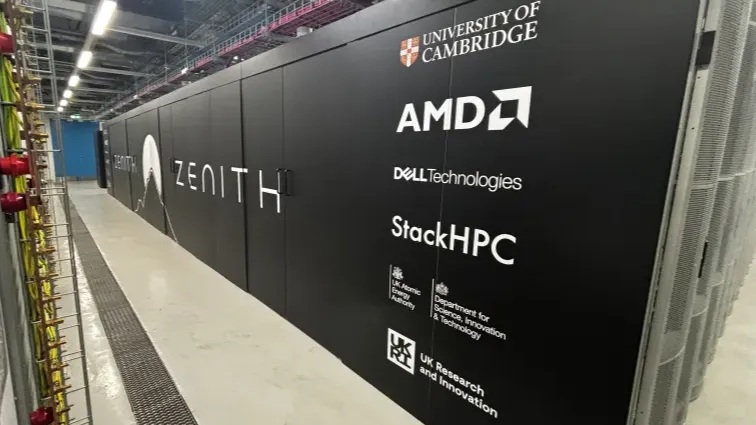
AMD, Dell Technologies, and the University of Cambridge have announced the launch of the Zenith supercomputer, alongside a new public-private initiative for AI research known as the Sovereign AI Innovation Lab (SAIL).
Zenith is the upgraded version of the Dawn supercomputer, powered by 5th Gen AMD EPYC processors and AMD Instinct MI355X GPUs that the companies said deliver six times the performance of its predecessor.
It is the result of a £36m upgrade announced by the government in February.
The University of Cambridge said that Zenith will be used to speed up research across health, energy, and the environment, as well as to bring together the AI and simulation communities in a single machine.
SAIL will act as a hub for public and private sector researchers to collaborate on AI and evaluate its deployment. It will bring together partners across climate science, engineering, healthcare, public services, national-scale AI initiatives, and broader scientific research.
AMD said SAIL would also focus on producing open, interoperable AI infrastructure built on AMD computing platforms and software.
Another supercomputer, Sunrise, is under construction in a collaboration between the University, AMD, Dell, the Department for Science, Innovation and Technology (DSIT), Intel, the UK Atomic Energy Authority’s (UKAEA), and the data platform firm WEKA.
The government invested £45 million towards Sunrise in March. When active, the supercomputer will draw 1.4MW of power and will solely be used by researchers working on nuclear fusion. The firms target first Sunrise operations in June 2026.
Professor Deborah Prentice, vice-chancellor at the University of Cambridge said: “Zenith, alongside Sunrise and SAIL, transforms what the University of Cambridge can achieve. By bringing together world leading researchers with national scale AI computing power, Cambridge is now equipped to tackle some of the most complex challenges of our time, from cancer, to climate, to clean energy and turn discovery into real world impact.”
Zenith is part of the UK AI Research Resource (AIRR), a national supercomputing cluster that gives UK-based researchers free access to high-performance computing. It also includes the UK’s most powerful supercomputer Isambard-AI, which is housed at the University of Bristol and can achieve a peak performance of 216 petaFLOPs, or 216 quadrillion floating-point operations per second.


