







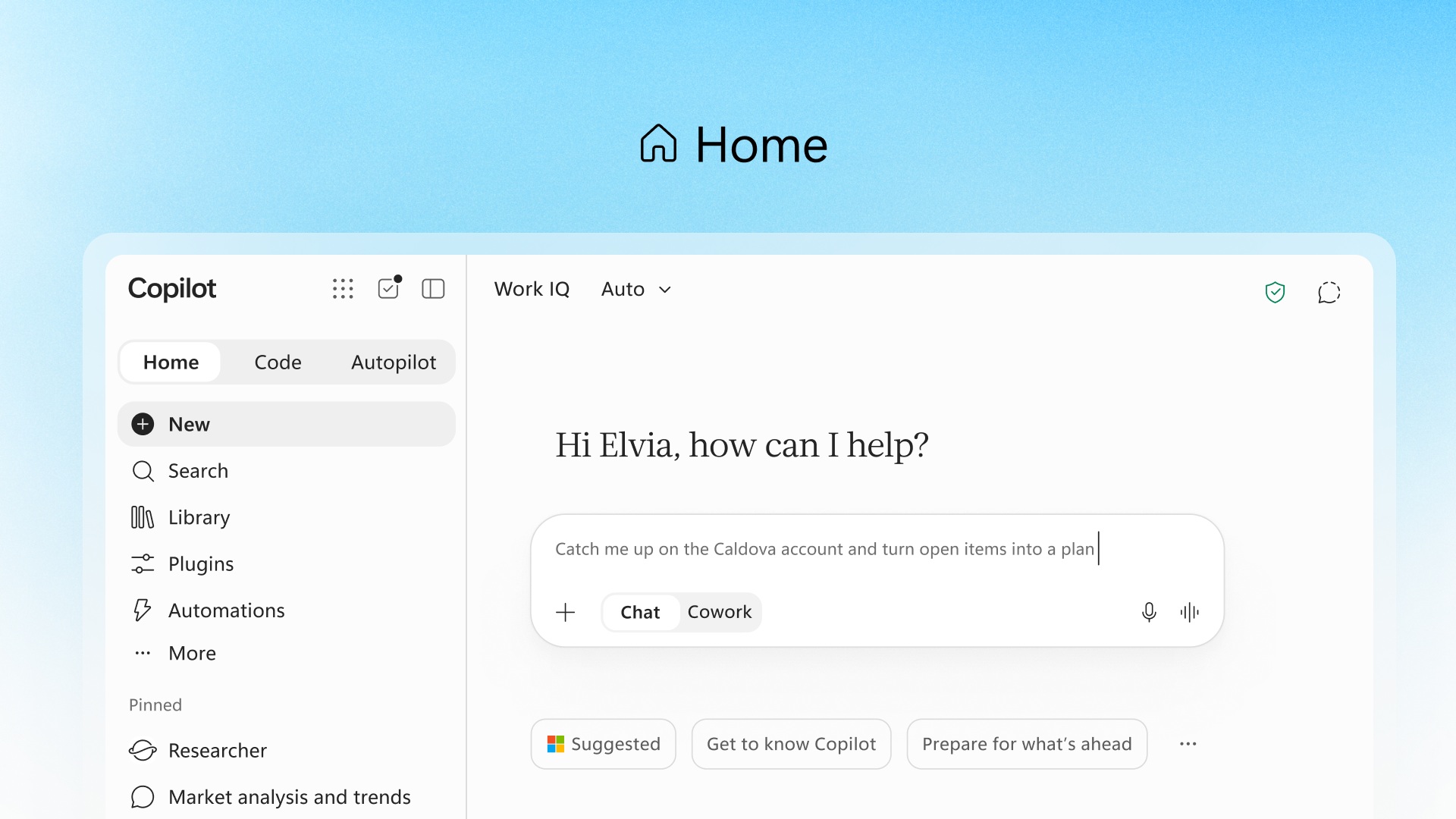
Microsoft has released a new version of the Copilot app, bringing together its chat, automation, and code-generation capabilities into one unified interface.
The Copilot app now defaults to a new home screen, a jumping off point for AI work. The chat interface on the home screen connects directly to its Chat functions, as well as the Office software suite through Office in Copilot.
Microsoft said it will soon add a Today function to the home screen, which will break down a user’s tasks for the day, suggest a priority order for tasks, and produce drafts to emails they need to send.
A toggle switch allows customers to use the same chat interface to send prompts to Cowork, Microsoft’s advanced automation offering that carries out multi-step tasks drawing on a user’s organisational data, Microsoft apps, and existing context.
In a demo, Cowork was able to create an entire PowerPoint presentation based for a customer launch, based on the context of an upcoming meeting flagged in Teams.
Microsoft said Copilot is now capable of adhering to brand guidelines for visual products and produces a version history so users can easily track which changes were made by AI versus human colleagues.
Alongside Home, users also have access to Code and Autopilot screens. Code is powered by the same underlying architecture as Microsoft’s flagship AI programming assistant GitHub Copilot, and aimed at everyday users rather than full-time developers.
Microsoft said Code can create apps, dashboards or trackers from within the Copilot app, based on natural language prompts and the enterprise data available within its secure sandboxed environment.
Autopilot is a rebranding of Microsoft Scout, the always-on “personal agent” powered by open-source OpenClaw frameworks, intended to complete background tasks such as automatic meeting scheduling, document preparation or channel monitoring.
To manage agentic spend, Copilot also now has embedded FinOps functionality. Microsoft said it is working to keep Copilot token spend low through a feature known as Auto, which routes user prompts to the best model for the task depending on accuracy, cost and speed.
In June, Microsoft changed Copilot to usage-based billing, meaning that enterprises pay more to use frontier models such as OpenAI’s Astra than more lightweight offerings.
Microsoft added that in the near future, users will not need to choose whether their prompt is carried out by Chat or Cowork as the system will automatically route inference to the correct systems depending on the context of the prompt.
To ensure the Copilot app produces results based on real data, Microsoft also announced that it is now directly grounded on its semantic layer Fabric IQ, which connects enterprise data with its ontology.
As a result, Copilot can now complete user tasks by drawing on information from directly from Dynamics 365 and Power Platform, without any need to set up separate pipelines or connectors.

