






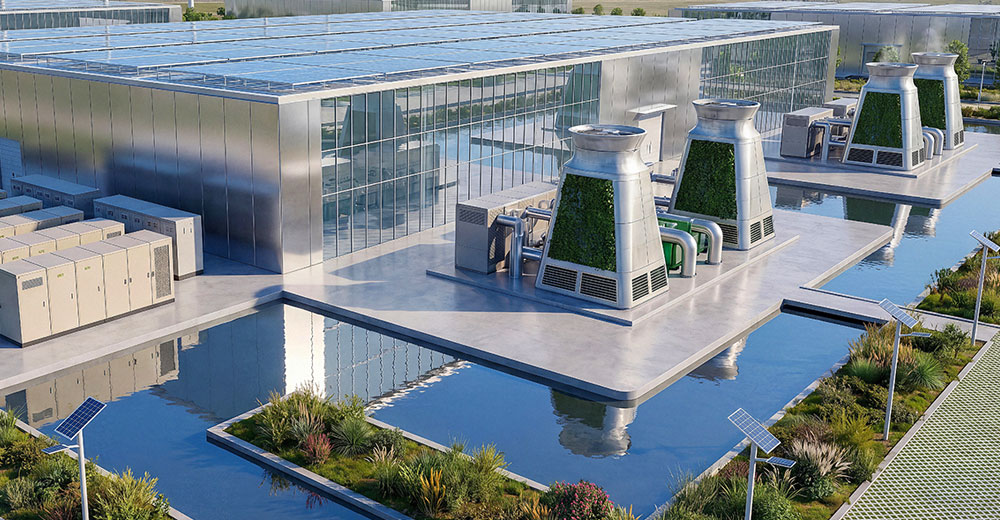
Blanket moratoriums and federal mandates aren’t the answer to growing concerns about the impact of data center proliferation on local water supplies, according to a report released Monday by a science and technology policy think tank.
“Technology exists, and policy instruments are available, to develop a new, state-led model of water governance for data centers and other large industrial users,” noted the report by Robin Gaster, research director of the Information Technology & Innovation Foundation’s Center for Clean Energy Innovation.
“What’s missing is institutional coordination, regulatory specificity, and a set of standardized mechanisms and metrics,” he added.
“You can’t fix what you don’t measure, and right now nobody measures water consumption the same way on a state or federal level,” explained Stuart Lacey, founder and CEO of Labrynth, a global platform for streamlining regulatory, permitting, licensing, and compliance processes for heavily regulated industries.
“State officials, regulators, and communities are all left guessing about storage and consumption,” he told TechNewsWorld.
“More than $130 billion in projects got delayed or scrapped in the first quarter of this year, and very little of that was about actual scarcity,” he said. “It was about trust, and trust starts with data everyone can see.”
Fraction of National Consumption
The report noted that data centers directly consume only a small fraction of the nation’s water supply.
The most widely used estimate of water consumption by data centers is from the Lawrence Berkeley National Laboratory, which concluded that data centers directly consumed 17.4 billion gallons annually in 2023 and indirectly consumed another 211 billion gallons for electricity production, or 12 times the amount of direct consumption.
All told, it continued, that would amount to less than 1% of total U.S. water consumption.
“Data centers in the United States [directly] consume roughly 17 billion gallons of water per year,” said Mark Meckler, president of the Convention of States, a group advocating a convention to amend the Constitution to limit federal power and impose fiscal constraints.
“That’s not even a third of a percent of all water usage,” he told TechNewsWorld. “By comparison, golf courses consume somewhere between 450 and 500 billion gallons of water. Data centers don’t even make a mark in that if you double their water usage.”
Gaster noted in a statement that communities are not wrong to be concerned about what large data centers mean for local water supplies, but treating the whole country as if it has the same water problem will produce bad policy.
“Arizona, Pennsylvania, Georgia, and Virginia face different water realities,” he said. “The answer is not to stop data center development. It is to make water impacts visible, measure them consistently, and regulate them where the local watershed actually needs protection.”
Meckler asserted that water consumption should be managed at the local level. “If a data center is looking to be sited somewhere, it should be required by local jurisdictions, from the state all the way down to the municipal level, to demonstrate what [the] water usage will be and how it’s accounting for it.”
Water Math Doesn’t Work Anymore
Data centers use so much water for the same reason any heat-intensive industrial operation does: they generate enormous amounts of heat that has to go somewhere, explained Whitaker Irvin Jr., president and CEO of Q Hydrogen, a developer of sustainable hydrogen energy technologies in Park City, Utah.
“The servers and networking equipment inside a modern AI data center run hot, and if you don’t pull that heat out, the equipment will fail,” he told TechNewsWorld.
“Water has historically been one of the cheapest and most effective ways to do that at scale,” he explained, “but with the rapid growth of AI and digital transformation, the scale has grown dramatically.”
“They are now essentially small power plants in their own right,” he continued, “and the water math that worked before doesn’t hold up when you’re multiplying it across hundreds of facilities in regions that are already under water stress.”
He added that indirect water consumption by data centers is where the staggering numbers come from and is the piece the industry has been slowest to figure out.
“Every megawatt of power a data center draws from the grid has a water footprint attached to it somewhere upstream, whether that’s in the gas plants, coal facilities, or nuclear stations generating the electricity to run it,” he said.
“The industry has gotten pretty good at telling a story about what happens inside the building, but hasn’t been nearly as honest about what’s happening in the power generation life cycle that makes the building run the way it does,” he added.
New Cooling Designs
The report also noted that the technology to sharply reduce water use already exists. New data center cooling systems can use little or no water directly, and some hyperscalers are already adopting zero-water cooling designs, it explained.
Nvidia has announced liquid-cooling technology for its Rubin generation of AI infrastructure that can reduce water consumption to near zero, it added, while Microsoft has introduced AI-optimized data centers that use closed-loop systems with zero water for cooling operations.
One of the most practical near-term cooling options for high-density AI systems is closed-loop, direct-to-chip liquid cooling, said Lillie Karch, a senior director at EY-Parthenon, the global strategy consulting arm of Ernst & Young.
“Instead of cooling the whole room, the cooling system brings liquid directly to the hottest parts of the server,” she told TechNewsWorld.
“In a closed-loop system, the coolant is recirculated rather than continuously evaporated,” she explained. “That can significantly reduce the need for fresh water, especially when paired with dry coolers that eject heat to outdoor air instead of using evaporative cooling towers.”
However, she acknowledged a tradeoff to the technology: complexity. “Direct-to-chip liquid cooling requires specialized cold plates, piping, pumps, leak detection, and maintenance practices,” she said. “But for the very high-density chips now going into production, liquid cooling is increasingly less of a luxury and more of a necessity.”
Water Data Required
The report also recommends requiring all large industrial users to disclose water-use data. Water use should be tied to performance standards rather than adoption of specific technologies, and water and electricity regulators should develop joint review protocols.
Requiring water data from large users is the right structure, and it mirrors what is already happening on the electricity side, noted Mark McNees, director of social and sustainable enterprises at the Jim Moran College of Entrepreneurship at Florida State University in Tallahassee, Fla.
“The core problem is that there is no accurate national data on how much water data centers consume, because facility-level data is not collected consistently, and indirect consumption through power generation is harder still to capture,” he told TechNewsWorld.
“You cannot manage what you cannot measure,” he said. “Standardized facility-level disclosure of total withdrawals, total consumption, water source, peak-day demand, and full-build projections is the foundation on which everything else depends.”
“Technology-neutral performance standards are smarter than picking winners,” he added. “Mandating a specific cooling technology locks in today’s engineering and freezes out whatever comes next. A performance standard sets the target for water use and lets operators meet it, however, the economics and the local watershed allow. It also travels better across a diverse industry, since a facility in Arizona and one in Virginia face very different water realities.”
He acknowledged that one of the biggest obstacles to data collection will be confidentiality. “Economic development deals routinely include terms that block disclosure of resource use,” he explained.
“States have the leverage to fix this because they are the ones offering the incentives,” he continued. “The report’s point that disclosure rules should override blanket confidentiality claims for core water metrics is the crux.”
“Total water use is a public-resource question, not a trade secret,” he argued. “States can use the same economic development levers that attract these projects to require disclosure as a condition.”
“Reporting also has to be independently audited at the state level to have teeth,” he added.


.jpeg "Tim Cook steps down after 15 years, replaced by hardware head")