








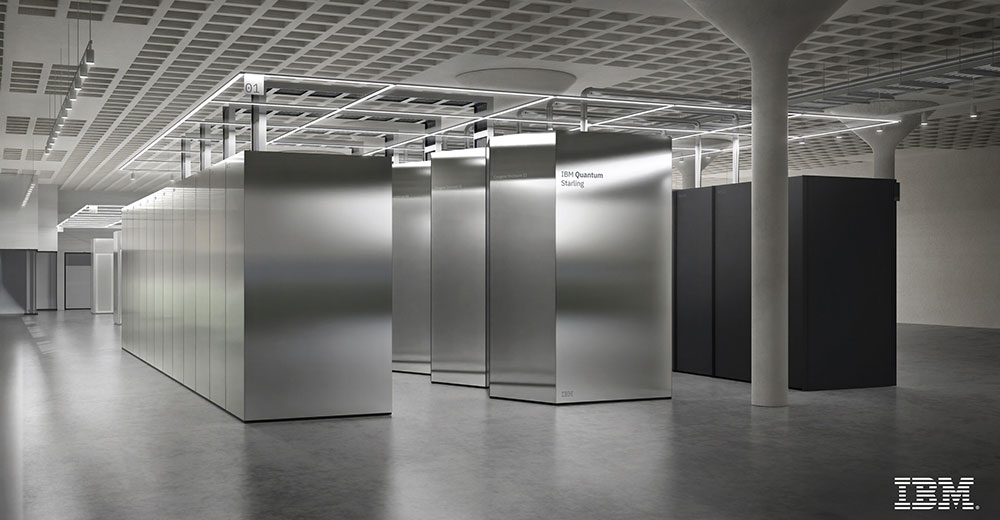
IBM on Wednesday announced that it has successfully joined and cooled two cryogenic quantum “fridges,” demonstrating a modular architecture designed to eventually link hundreds of quantum chips into more powerful quantum computers.
Big Blue cast the development as a milestone on the company’s path to delivering IBM Quantum Starling in 2029, which IBM expects will be the world’s first fault-tolerant quantum computer and will integrate advances across error correction, processor design, decoding and systems engineering.
“Bringing fault-tolerant quantum computers to industries depends on several fundamental advances,” Jay Gambetta, director of IBM research and IBM fellow, said in a statement.
“The successful connection and operation of these cryogenic modules signals a leap forward in that direction,” he continued, “and will accelerate our progress alongside continued innovation in quantum hardware, software, and algorithms.”
Scaling Up in the Deep Freeze
IBM explained that the quantum fridges, which are more than eight feet tall and eight feet wide, can be jointly cooled down to 4 Kelvin (the temperature of liquid helium) in under five days and reach a final temperature below 15 millikelvin shortly thereafter.
“Temperature is a challenge because materials that are superconducting are only stable at extremely low temperatures,” explained Luke Wang, an equity analyst with Morningstar Research Services in Chicago.
“Qubits are also fragile, and temperature is one of the factors that can impact their performance,” he told TechNewsWorld.
IBM also noted that each module’s vacuum enclosure offers up to 12 times more wiring space than the most widely used IBM quantum systems, enabling more chip-to-chip connections both within and between modules.
The company plans to install Nighthawk processors in the modules later this year for additional testing and aims to use the architecture to support at least 1,000 programmable qubits by 2027.
“Superconducting qubits have to sit at a few thousandths of a degree above absolute zero, colder than deep space, inside a dilution refrigerator,” explained Yuval Boger, chief commercial officer for QuEra Computing, a builder of quantum computers using neutral atoms, in Boston.
“That works well for tens or hundreds of qubits, but every qubit you add brings more control wiring into the cold environment, and each wire carries heat,” he told TechNewsWorld. “So cooling power, wiring density, and footprint all become constraints as you scale, which is a major reason modular, chip linking approaches like this one are being pursued.”
Incremental Milestone
Boger agreed that the development is a meaningful engineering milestone.
“For years the hard question in superconducting quantum computing has been how to grow beyond a single chip,” he said. “Linking many chips into one machine reframes scaling as a modular systems problem, which is how classical supercomputing matured.”
However, he added: “It is worth being precise about what is being scaled. This is progress on physical qubits and interconnects. If successful, it will reduce the significant cost, energy consumption, and space that superconducting qubits require by reducing the number of cryogenic cooling units.”
Sam Lucero, an independent strategy and research consultant in Phoenix and former quantum computing analyst with global research and consulting firm Omdia, termed the IBM development incremental. “I think it’s an incremental step toward their path to creating infrastructure that scales better than traditional dilution refrigerators have scaled,” he told TechNewsWorld.
“I think it’s really necessary that they do this to make quantum computers that are economically sensible in the future,” he added.
Scaling Without Destabilizing Qubits
The announcement is significant because practical quantum error correction is drawing closer, observed Garfield Jones, executive vice president for strategy and research at QuSecure, a maker of quantum-safe security solutions in San Mateo, Calif.
“The ability to link quantum chips together with a breakthrough in cryogenic architecture will stabilize qubits, increasing quantum computing power,” he told TechNewsWorld.
“Qubits don’t perform well in noisy environments, so they need a cold, dustless, quiet environment to stabilize,” he explained. “The ability to link chips together without disturbing the qubits is huge.”
IBM’s multi-module arrangement is an improvement in cryogenic dilution-refrigeration design that should make the technology less expensive, added Roger Grimes, of Palm Harbor, Fla., a post-quantum field CISO and author of 17 books, including three on quantum computing. “I haven’t seen pricing, but this should reduce pricing per qubit and chip,” he told TechNewsWorld.
Supercooling Qubits
Grimes explained that the most difficult remaining challenge for quantum computers is making and managing qubits that remain stable and on task until a problem is solved.
“The rest of the natural world — mostly electrons or photons — is trying to interfere with those computer-created qubits and prematurely destabilize them before the problem is solved — called decoherence,” he said.
“Most vendors try to solve premature decoherence using additional error-correcting qubits and processes,” he continued. “It sometimes takes many additional error-correcting qubits — called ancillary qubits — per ‘working qubit’ to create what the quantum world calls a ‘logical qubit.'”
Grimes added that in most quantum computers, there are many “physical qubits” per logical qubit. “Needing fewer physical qubits per logical qubit remains one of the fundamental challenges and goals of today’s quantum computers,” he said.
“In general, if you can supercool computer qubits down to just above 0 Kelvin, there tends to be a lot less natural interference and qubits remain cohered, versus decohered, longer,” he continued.
“Cryogenic dilution solutions were among the first ways to do supercooling,” he added. “Unfortunately, cryogenic dilution supercooling solutions are expensive to buy, big, energy-intensive, and expensive to operate.”
Dilution Solution Alternatives
Other quantum architectures, including neutral-atom and trapped-ion systems, do not require the same millikelvin dilution refrigeration used for superconducting qubits.
In trapped-ion systems, atoms are cooled with lasers to keep them still, but there is no dilution refrigerator and no cryogenic plumbing around the machine.
In neutral-atom systems, the practical advantages are lower power draw, a smaller facility footprint, and simpler integration into an HPC center or data center that was never designed to host a fridge running at millikelvin temperatures.
“There are architectural benefits beyond temperature as well,” QuEra’s Boger added. “Atoms are naturally identical. They can be arranged in large reconfigurable arrays, and because you can physically move a qubit to interact with any other qubit, you get all-to-all connectivity without the overhead that fixed chip layouts incur.”
He conceded, however, that superconducting gates are faster on a single-operation basis, and superconducting has the most mature software ecosystem today.
“This is healthy competition rather than a single winner emerging,” he said. “Superconducting, neutral atoms, trapped ions and photonics are advancing on different axes, and that diversity is good for the field, because we do not yet know which approach wins for which workload.”
“Physical qubit counts and chip counts make for clean headlines, but the number that will actually matter is reliable, logical qubits,” he added. “That is the race worth following over the next few years.”


